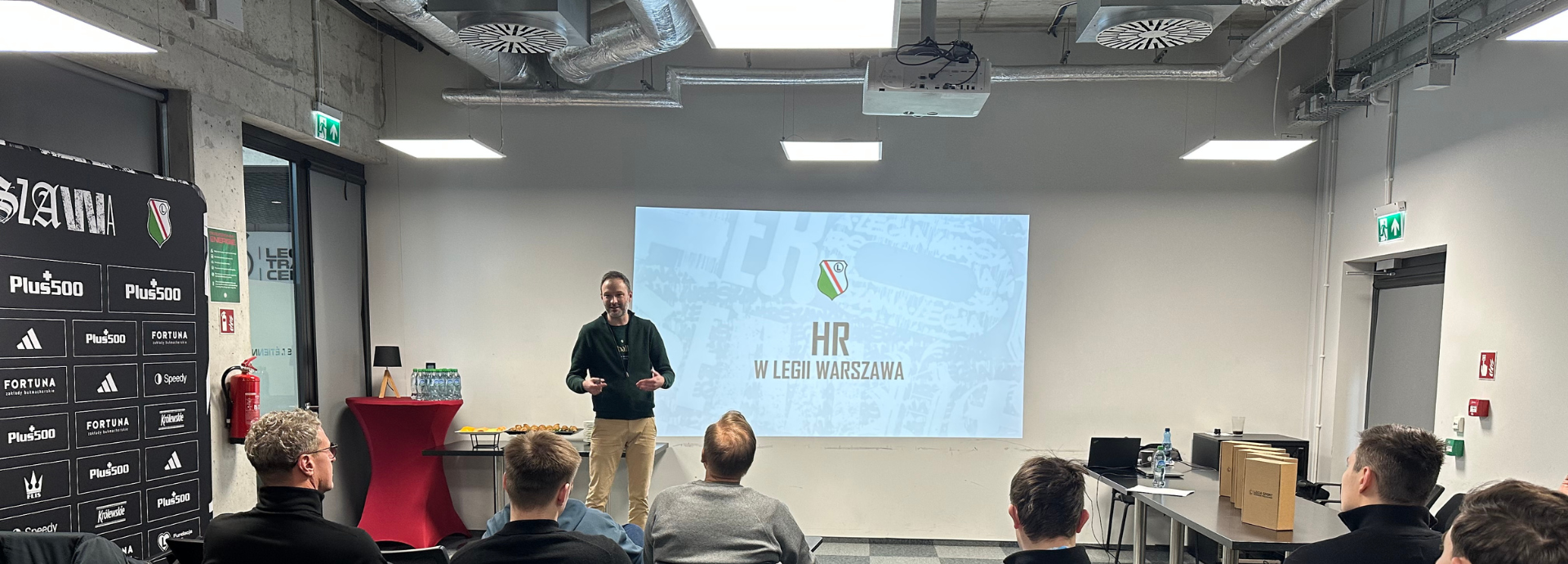
Professional sport increasingly operates beyond the simple logic of results on the pitch. Modern sports organisations function within a complex regulatory and social environment in which legal frameworks, community responsibility and the conscious management of an organisation’s impact on its surroundings are becoming just as important as sporting success. These were precisely the topics explored during the sixth session of the Legia Sport Business Programme, held at Legia Training Center.
The scale of the challenges facing sports organisations today is immense. According to PwC, the global sports market already exceeds $600 billion, and with its growth comes an increasing number of legal regulations and rising social expectations towards clubs and federations. Sports organisations now operate at the intersection of sports law, national and European regulations, environmental requirements and social responsibility standards.
During the session, programme participants had the opportunity to examine these challenges from several perspectives – legal, organisational and social.
Jakub Laskowski, Director of Legal and Sports Administration at Legia Warszawa, spoke about the realities of operating a sports club within the complex system of sports regulations. Modern sports organisations must navigate an environment shaped by federation and league rules, national legislation and the requirements of international institutions. As he emphasised, professional legal management and strong compliance structures are becoming one of the key foundations for the stable development of sports organisations.
The relationship between sport and its social environment was addressed by Łukasz Sekuła, Vice President of the Management Board of Legia Kosz, who highlighted the growing role of sports clubs as social institutions. Across Europe, clubs are increasingly developing projects aimed at local communities, young people and new groups of supporters. UEFA research shows that organisations implementing long-term social programmes also achieve higher levels of fan identification with the club and stronger supporter loyalty.
Kamil Dudek, Project Manager at the Legia Foundation and a graduate of the fourth edition of the Legia Sport Business Programme, presented the perspective of social initiatives delivered by sports organisations, particularly those focused on children and youth development. When properly designed and managed, sport can be one of the most effective tools for building social capital and supporting the development of young people.
An important part of the discussion also focused on inclusion in sport, addressed by Katarzyna Haczewska, Organisational Culture and Sustainability Manager at Legia Warszawa. She highlighted the importance of creating a sports environment accessible to diverse social groups and the need to build more open and inclusive organisational structures within sports institutions. In many European leagues and federations, diversity and inclusion initiatives are increasingly becoming a key component of organisational strategy.
The session clearly demonstrated that the future of professional sport is not only about business growth or sporting success, but also about the ability to operate responsibly within the surrounding social and regulatory environment.
If you would like to gain deeper insight into the inner workings of professional sport, meet industry leaders and develop your career in this sector, you can now apply HERE for the sixth edition of the Legia Sport Business Programme.
Recruitment is already underway, and the programme begins in October.